define dry --plain-english
DRY
TLDR:Write it once, reuse it everywhere.
A while back I changed our return policy and spent the next month finding it in places I forgot it lived. The website. The email auto-reply. A help doc. A little popup at checkout. Every time I thought I'd caught them all, another one surfaced with the old policy still sitting there, confidently telling customers the wrong thing.
That mess has a name in software. The opposite of it is DRY.
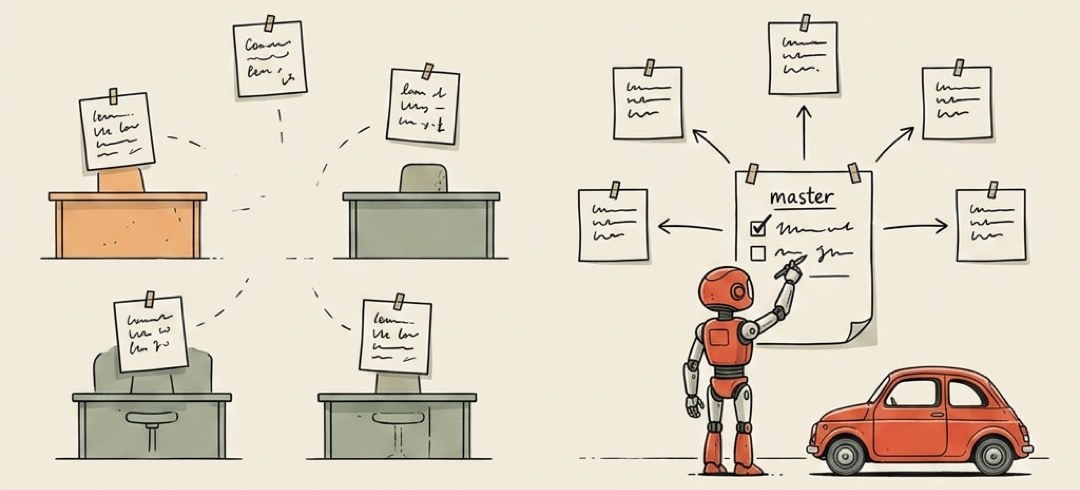
DRY stands for Don't Repeat Yourself. The rule is simple: write a piece of information or logic exactly once, in a single place, and have everything else point back to that one spot.
Here's the everyday version. You save a friend's number in your contacts instead of scribbling it on ten sticky notes around the house. When they get a new phone, you update one entry. Every text, every call, every app that reaches for that contact now uses the new number automatically. You didn't go hunting. You changed it in the one place it actually lived.
Code that isn't DRY is the sticky-note version. The same rule gets copy-pasted into five spots:
- the checkout page
- the confirmation email
- the mobile app
- the admin dashboard
- some report nobody's looked at in a year
Now picture changing that rule. Free shipping moves from $50 to $75, say. You've got five places to update, you'll remember four, and the fifth one quietly keeps promising the old deal to every customer who hits it. Nobody notices until someone does, usually a customer, usually at the worst time.
This is why "isn't DRY" is an insult, and "DRY" is a compliment. When something is written once and pointed at from everywhere, a change is one edit and you're done. The whole system updates in lockstep because it was all reading from the same source the entire time.
Why you, a non-coder, actually care about this:
It tells you how scary a change really is. "Can we update X everywhere?" When the answer is fast and confident, the code is probably DRY. When you get a sigh and "well, it's in a few places," that's the sticky notes talking, and that's where the sneaky bugs hide.
It's a thing you can ask your AI for, out loud. You don't need to know how it's done. You just need the words.
That second point is the unlock. When an agent is building for you and you can feel it pasting the same thing over and over, you can stop it with one line:
This logic is repeated in a few places. Pull it into one spot and have everything reference that, so I only have to change it once.
That sentence makes you sound like you've been doing this for years. You haven't. You just know the rule.
One honest caveat, because DRY can be taken too far. Two things that look alike aren't always the same thing. Sometimes two pages happen to show "$50" today for completely unrelated reasons, and forcing them to share one source just because the number matches creates a worse tangle later when one of them needs to change and the other doesn't. The real test isn't "do these look identical." It's "would I always want to change both of these together." If yes, make it one. If no, leave them be.
Write it once. Point everything at it. Change it in one place, and watch the whole thing update on its own.