define vector-database --plain-english
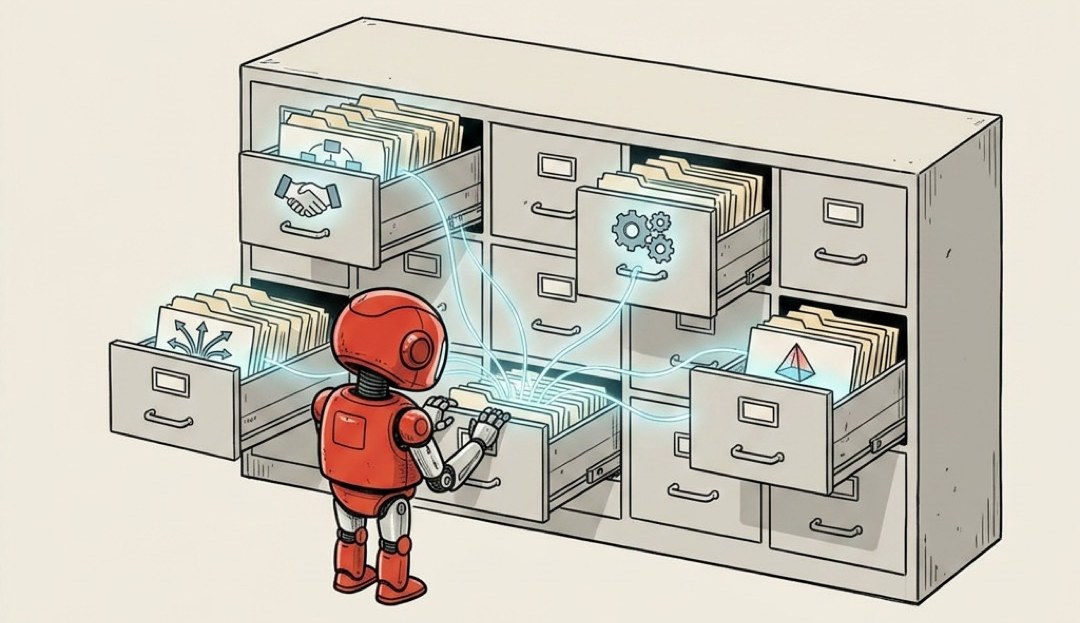
Vector Database
TLDR:Storage that finds things by meaning, not exact words.
Picture the best record-store clerk you've ever met. You don't know the name of the song stuck in your head, so you hum eight bars, badly, and they go "oh, you want this" and pull the exact record. You never said a title. You never said an artist. You handed them a vibe and they walked straight to the right shelf.
A normal database can't do that. A vector database is built for exactly it.
First, the split that matters. A regular database is a literalist. It answers exact questions and only exact questions:
- "Find the customer named Smith."
- "Pull every order over $100."
- "Get the row with this ID."
Spell it right and it's perfect. Spell it wrong, or ask it something fuzzy, and it shrugs. It matches characters, not meaning. To a normal database, "the order got lost" and "my package never showed up" are two total strangers. Zero words in common, so zero match.
A vector database is the opposite kind of mind. It doesn't ask "do these share the same words?" It asks "do these mean roughly the same thing?" And that one shift is the whole entry.
How it pulls off the hum-a-song trick. Before anything goes in, every piece of text gets turned into a long string of numbers that captures its meaning (that conversion is its own thing). Don't sweat the math. Just picture every sentence, document, and support ticket getting dropped as a single dot onto a giant map. Things that mean similar things land near each other. Things that mean nothing alike land on opposite ends of the map.
So on that map:
- "my package never arrived" and "the order got lost" sit practically on top of each other
- "I love the packaging" lands way across town
- "what's your refund policy" sits somewhere else entirely
The vector database is the thing that stores millions of those dots and, the instant you ask, finds the ones sitting closest to whatever you just handed it. You give it a new sentence, it drops a fresh dot on the map, looks around, and grabs the nearest neighbors. Closest on the map means closest in meaning. That's the entire job.
Where you've actually felt this. This is the engine humming under AI that "knows" your stuff. When you upload a pile of documents and the AI answers a question using them, it is almost never reading all of them. It can't. They wouldn't fit in the room. Instead:
Your question gets dropped onto the map as a dot.
The vector database grabs the handful of chunks sitting closest to it (the relevant bits, not the whole library).
Those get handed to the model, which writes the answer from them.
The fancy name for that loop is RAG, retrieval-augmented generation, and you'll hear it constantly. Strip the jargon and it's just: go fetch the relevant pages first, then answer. The vector database is the part that does the fetching, and it fetches by meaning instead of by keyword. That's why it can pull the right paragraph even when your question and the paragraph don't share a single word.
One honest catch, because it's the same trap as everywhere else in AI. "Closest in meaning" is a best guess, not a certainty. A vector database hands back what's nearest, and nearest isn't always right. Ask something your documents genuinely don't cover and it'll still cheerfully return the closest dots it can find, which might be close to nothing useful. Garbage that's near your question is still garbage. So when an AI answers from your files and the answer feels a little off, this is often where it slipped: it retrieved the closest-looking pages, not the correct ones.
The clean way to hold the difference:
- A normal database finds the row that matches.
- A vector database finds the rows that mean the same thing, even when they say it in totally different words.
One is a literalist with a filing cabinet. The other is the clerk who hears eight bad bars and walks straight to the shelf.