define trace --plain-english
Trace
TLDR:Something in your app is slow, and "the app is slow" tells you nothing useful.
Something in your app is slow, and "the app is slow" tells you nothing useful. A trace is how you find the one station that's actually dragging.
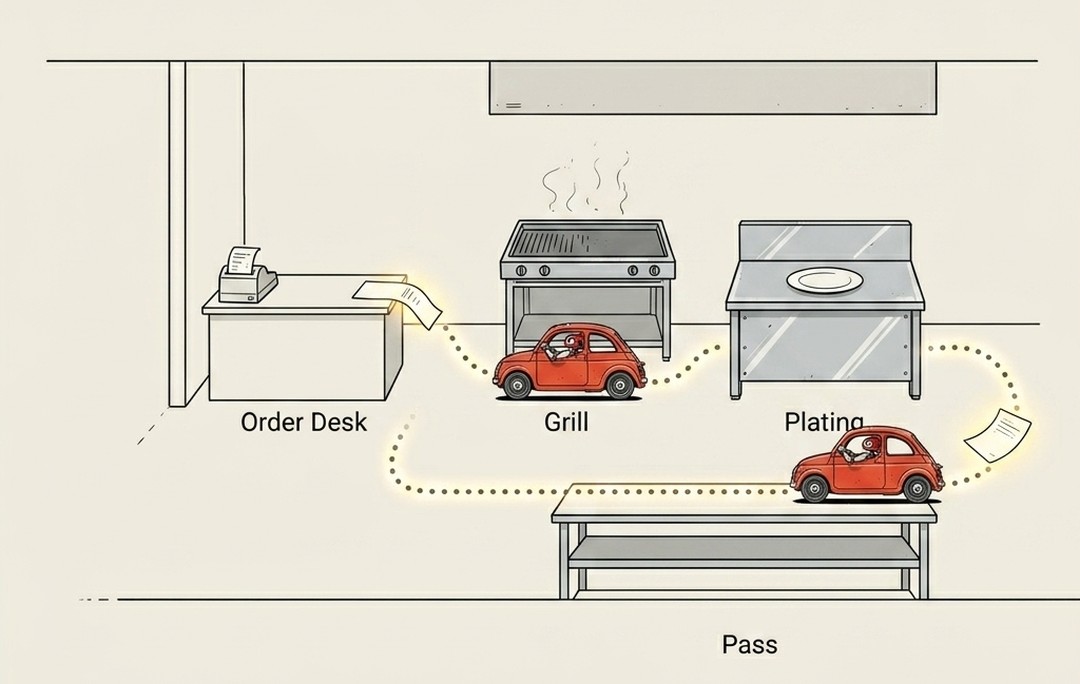
A grown-up app isn't one kitchen. It's a line of stations, each handing the order off to the next. The order comes in at the desk, goes to the grill, moves to plating, waits at the pass, then heads out the door. Each of those handoffs is a different piece of software doing its part. (This is the kitchen behind the dining room, scaled up: lots of stations, one order moving through all of them.)
Now the order takes forever to come out, and a customer's annoyed. "The kitchen is slow" doesn't help anyone. Which station? Did the grill back up? Is plating waiting on a garnish? You can't fix what you can't locate.
A trace follows one single ticket through every station and times each step. You highlight one order and watch its whole journey: a blink at the desk, a blink at the grill, then three full seconds stuck at plating. There's your culprit. The trace didn't watch the whole kitchen at once. It followed one ticket and showed you exactly where the time went.
This is the cousin of the log, and the difference matters. A log is one station's notebook: everything that happened at the grill, written down in order. Useful, but it only knows about the grill. A trace stitches together one order's path across all the stations at once. The log is per-place. The trace is per-order, end to end. When a problem hides in the handoffs between stations, no single log catches it, and a trace does.
(There's a second thing also called a "trace" that you'll meet later, the one that prints when a single program crashes. That one zooms all the way into one station's machinery. This one does the opposite: it pulls back and follows one order across the whole line. Same word, opposite zoom.)
Why a non-coder should care. When something feels sluggish and a developer says "let me pull a trace," they aren't staring at the entire system hoping to spot trouble. They're following one request to find the slow hop. It's the difference between "checkout feels laggy" and "checkout spends three seconds waiting on the tax service." One is a shrug. The other is a fix.
A log is one station's diary. A trace follows one order through every station, so "it's slow somewhere" becomes "it's slow right here."